Total Pageviews

Showing posts with label monarch. Show all posts

Wednesday, December 16, 2015

Festive Colors in the December Garden and a Sad Butterfly Tale

We've had some strange weather so far this December. It's gone from warm and muggy to cold, wet and windy, but certainly nothing approaching "Christmas-y".  But I do have some festive colors in the garden, courtesy of the holly and the bottlebrush.


Earlier in the year, when the Savannah holly was blooming, it was covered in bees, enjoying the nectar.  Now it's the bottlebrush's turn to be the center of bee attention.  If you click on the photo to see the larger image, there are two bees in this picture.


The Savannah holly is now covered in bright red berries, which I hope the birds enjoy, although I've never really seen them.  The bushes are big enough that I can even snip a few branches and bring them inside to add to my Christmas decorations, something I have always wanted to do.

*****

On another note - I mentioned in one of my earlier posts in autumn that I had been seeing butterflies around and then some caterpillars.  Unfortunately we didn't have much luck with Monarchs this year.  In previous years we had 15 or more chrysalises on the fence, the house eaves and elsewhere, and lots of successful hatching.  

This year, not nearly so many and even sadder, it appears that at least one female who was laying eggs was infected with OA, so her caterpillars either never made it to the chrysalis stage, or the chrysalis never hatched.  


I saw one butterfly at the beginning of November whose wings didn't unfold properly - a symptom of OA infection.  All I could do was pick it up and set it the only remaining zinnia I had in the garden at the time.  It had disappeared completely by the next day.

 
And on December 12th I found this male butterfly with half his wing missing fluttering on the lawn. Luckily I had planted some pansies a couple of weeks ago, or I would have had no flowers at all.  I let him crawl on my hand and set him on the container of pansies and he immediately probed the center of a pansy with his probiscus and starting feeding.

I brought the container on to the covered patio that night as we were expecting heavy rains and a cold front.  He was still alive, but very lethargic the next day because the temperature had dropped, but once I moved the container back into the sun and he warmed up, he started crawling around the pansies feeding again.


Today is December 16th and he is still out there.  I check on him regularly and have had to pick him up off the ground and put him back in the pansy container a couple of times.

Obviously, his days are numbered, and he won't be migrating, but as long as I have pansies, I'll try and make sure he can at least feed.

I've had similar events happen in the past and it always saddens me. I''m not sure what the answer is, but I'll just do what I can.  In fact, I think I'll go check on him now.
 
Words and photographs by Jayne Wilson, Green and Serene, Jayne's Country Garden.

Saturday, November 7, 2015

November in the Garden

When I lived in England, I was always accustomed to seeing butterflies floating about the garden in June, July and August.

In fact I remember earlier this year, being rather despondent at the lack of butterflies in the garden.

I should have remembered that our prime butterfly month is October, and often in to November and beyond.

The garden was ready for them too -- the Vitex, which has bloomed only sporadically all summer, now has quite a few lovely sprays of booms on it.  Just in time to feed this hungry visitor.


We still have some blooms on the tropical milkweed too, but in most cases, the leaves have been eaten by voracious caterpillars.


This photo was actually taken several days ago.  When I went back out to see how he was doing, there was no sign of him.  Then later in the day, I sat down on the patio and noticed this underneath the small table on the patio.


Is it him?  I'll never know, but I'm looking forward to keeping a close eye on it while it goes through its transformation.


And elsewhere around the garden, the milkweed is making preparations for next year.


The brush pile in the utility corner was getting out of hand, so I knew I first needed to tackle the compost bin, which has been more or less ignored most of the year, with the exception of the occasional "stir".

I wasn't sure how much, if any, good compost we would have but was very pleasantly surprised to find the bottom half of the bin filled with dark, moist, rich compost.


I dug out several inches worth and added it to the vegetable beds, in readiness for next year.  Then I got out the "Yard Butler" and mixed up what remained in there and encouraged it to move down ground level to replace what I had just removed.

This provided a few inches of space at the top, so I was able to spend a happy afternoon using our chipper/shredder to shred spent annuals, shrub and tree trimmings and leaves.


There is still some work to be done on the brush pile (while still leaving some to shelter the local wildlife) but it's been steadily raining all day today, so I won't be shredding anything until it dries out.


Maybe next week....


Words and photographs by Jayne Wilson, Green and Serene, Jayne's Country Garden.

Saturday, June 13, 2015

Butterflies and the Bird Buffet


I've been trying all week to catch a photo of one of the Monarchs that have been floating and flitting around the garden all week. I was finally able to snap a photo when one of them alit on the tropical milkweed in the island bed and was still for a moment.

One appeared to be laying eggs last weekend, but I can't see any eggs and haven't spotted any caterpillars, so my assumption may have been wrong.  I suppose time will tell.


It was marginally cooler today (only 88 degrees), so I put on a headband and went out to pull weeds.  Then, on a trip to the store to pick up bird seed, I was lured into the garden center and came out with a small flat of purple Angelonias, to help offset all the orange I have going on in the back yard.
But after sweating up a storm for half an hour or so, I retreated to the shade of the patio to sip ice tea and read a gardening magazine.  

That's when the show really started.  


First, along came this red-winged blackbird.  This is the first one I have seen this year.  He didn't stick around long, probably because I hadn't put any birdseed along the wall like I usually do.


Then I got quite excited when I saw this guy.  It's a young red-bellied woodpecker, too young to have a red cap on his head like his dad, although one of the photos below you can see it's getting a little rosy.


I had seen him during the week actually being fed by the male that visits our garden.  I watched closely to see if there would be a repeat performance.


Sure enough, after a few minutes, "dad" showed up. 

 Finally, I couldn't believe it when I realized the whole family was there on the wall - mum, dad and youngster!  I was thrilled to be able to capture this photo for the family album.  A first for me :-)

Then I realized I was being a bad hostess and that I really should put some seed out along the wall and fill the feeders.


Once I had done that, the white-winged doves that had been eyeing the scene from the power lines across the road came swooping down.


This mockingbird was quite happy enough to share as well.  He even tried some acrobatics to get to the suet, but the male woodpecker was the most skilled at that, happily hanging almost upside down to get to the suet/peanut mixture.


All in all, a lovely day in the garden.  I wish they could all be like this :-)


Words and photographs by Jayne Wilson, Green and Serene, Jayne's Country Garden.

Tuesday, May 26, 2015

The Monarchs are a-mating

Since we got back from vacation this weekend, I have seen a Monarch butterfly floating from bloom to bloom, enjoying the nectar.

I remember commenting to my husband that it would be sad if only one Monarch came by and this one didn't find a mate.

 Just now, as I was belatedly putting some birdseed in the feeders, my heart flipped as I saw something I couldn't quite explain. It was a Monarch flying around, but it appeared to have another, seemingly lifeless, Monarch attached and dangling from its body.

As I watched, it headed for our young pine tree and settled on a branch. Then I realized that the seemingly dead one wasn't dead after all and what I was seeing was, to coin a phrase used by another Houston area garden blogger, Dorothy at The Nature of Things, a little backyard porn.

I'll admit, this is something of which I haven't ever pondered the mechanics. 

Now I know. 

I'll leave it at that :-)


My recently planted native milkweed probably isn't big enough to sustain Monarch cats at the moment, but I do have some healthy tropical milkweed.  So she should have enough locations to lay her eggs.

I'll keep a lookout for them and keep you posted :-)

Words and photographs by Jayne Wilson, Green and Serene, Jayne's Country Garden.

Saturday, November 2, 2013

Brand New Monarch

We've had quite a lot of success with our certified Monarch Waystation, but with all the milkweed, caterpillars and chrysalises (chrysalii??) I've never actually seen a Monarch emerge.

Until today, that is.

I noticed yesterday that one of the chrysalises had turned color, so I knew it wasn't going to be long.

I went outside this morning, meaning to get a photo of the almost black chrysalis but when I got out there, I was too late for that particular photo, but right on time for the rest of the show!


I stood a couple of feet away, fascinated, and snapped several photos.


I was a little bit worried because although it was nice and sunny today, it was also quite windy and I thought the butterfly might get blown away before it was ready to fly.


In fact, after being buffeted around for half an hour or so, it did get blown down. I went outside and didn't see it so I assumed it had flown away, but actually my husband noticed it on the ground.  I put my hand down next to it and it crawled on to my fingers!

Thinking that what it needed was nourishment, I walked it over to the Dallas Red Lantana and set it down on the plant. The area had the double advantage of being in the sunshine and also protected from a lot of the wind.


It seemed to sit in one place for quite a while and I worried again that something was wrong, and that perhaps the episode would end the same way it did last Christmas when a Monarch emerged and was unable to fly.

 
But about 30 minutes later I went outside again and as I raised the camera to take another photo, the butterfly fluttered up and away over the wall.  Later still, I spotted a Monarch flying around in the garden looking strong and healthy.  I like to think it was "my" Monarch and that my humble little Monarch Waystation is making a difference.

We've still got three more chrysalises that I know of and I hope all goes smoothly for them too. 


Words and photographs by Jayne Wilson, Green and Serene, Jayne's Country Garden.

Sunday, December 2, 2012

What a Difference Two Hours Makes

Here we are in December and, although we had some cold weather and even some frosts earlier in the fall, the recent weather has been very mild.

Even so, I've been surprised at the number of butterflies we still have floating around the garden.  We've got Sulphurs, Gulf Fritillaries, Buckeyes and Monarchs.

At the end of October I blogged that we had Monarch caterpillars and chrysalises.  Who knew then that I'd be able to report another chrysalis in DECEMBER?

Mum and dad (visiting from England for the Thanksgiving Holiday) were mildly amused as I kept watch over the most recent caterpillar and probably thought I was nuts to get excited over it.

When I went out this morning to feed the birds at 9:51 am, I got even more excited when I noticed the caterpillar had attached himself to the fence and was starting to curl up.


I was totally amazed when I went to check on him later to discover that, in a period of just two hours he had completely transformed into a chrysalis! The photo below is time stamped 11:51 am!


For some reason, I thought it would take longer than that.  What a difference two hours makes!


Words and photographs by Jayne Wilson, Green and Serene, Jayne's Country Garden.

Thursday, October 18, 2012

A Banner Year

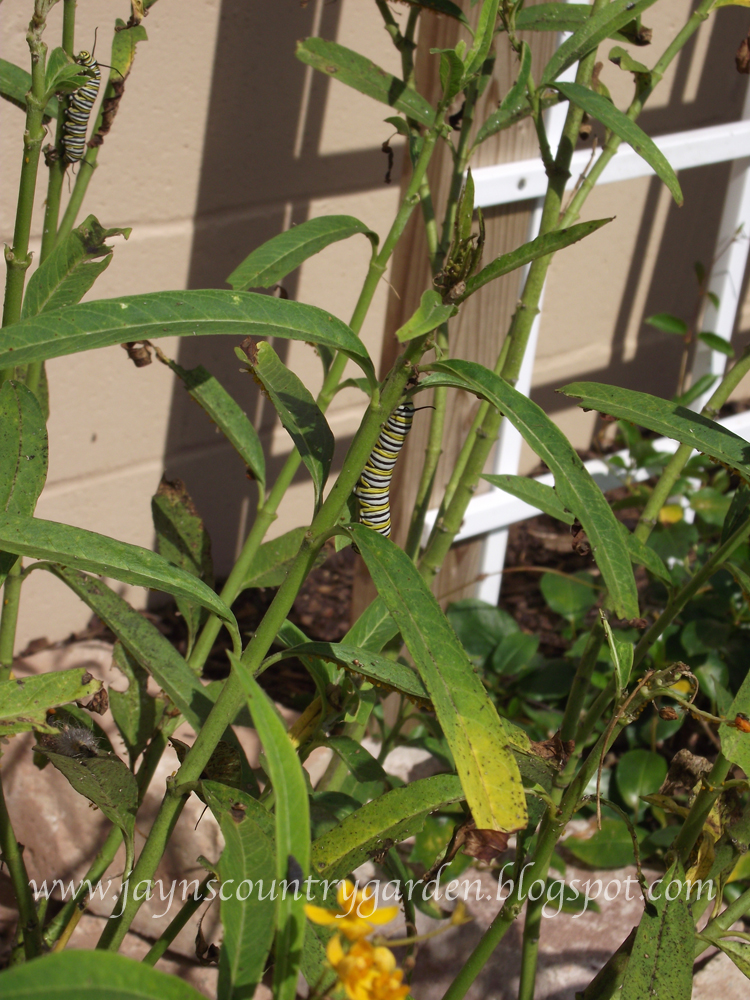
Just a couple of days ago, I blogged that we were still getting Monarch butterflies in the garden, and that we had a lot of caterpillars on the yellow Milkweed in the back garden (but none on the red and yellow variety).

I was worried that they would run out of leaves before they were ready to turn into chrysalises so I was out in the rain, snipping stalks with caterpillars on and relocating them to nearby plants!

Here's the yellow milkweed now:  as you can see, there's not a leaf on it, nor any caterpillars.

 Happily, the ones I relocated to the other milkweed plants are still doing well.


 But what  of the rest?

So far, I've counted four chrysalises -- including these two on the underside of the birdbath:


There are also a couple more on the fence:

 
I also saw a caterpillar crawling up the side of one of the planters, so I'm sure there will be a chrysalis there in the morning.

Looking back at my blog throughout the year, it's really been a banner year for Monarchs.  We first had caterpillars in the front garden back in April.

In June, we had so many chrysalises, I lost count of them all! 

At the end of June, we were lucky enough to witness some newly hatched Monarch butterflies.

In July, we had another generation of caterpillars, this time in the back garden.

By August, the second generation had eaten us out of house and home and had turned into chrysalises in some unusual spots and once again we got to witness new butterflies.

And now here we are in October, when I really thought we'd seen the last of them, we get to witness the miracle again. 

Something else I thought we had seen the last of for this year are hummingbirds.    I hadn't filled the feeders in a couple of weeks (but had neglected to take them down and clean them).

Imagine my shock when I saw a female ruby throat attempting to get a drink from one of them the other day!  

Luckily, we still have some blooms on the Rose of Sharon, the Vitex and the Flame Acanthus, so she wasn't going to starve. But I turned the kettle on then and there and made up some fresh nectar and later pulled the feeders down and cleaned them and refilled them.

I was able to get this photo of her.  My apologies for the poor quality but I was losing the light, plus I was taking the photo through a dirty window!

 
It's moments like these that make gardening in the brutal Texas summer a little easier to bearThis is why I garden and I still find it amazing that in four years we've accomplished so much.

Happy gardening all. 
 

Words and photographs by Jayne Wilson, Green and Serene, Jayne's Country Garden.

Tuesday, October 16, 2012

The Fall Garden

Ooops - here we are half way through October and this is my first blog post for the month.

My husband and I went up to Lake Conroe for a weekend getaway last week so I didn't get around to blogging.

I really haven't done much in the garden recently, but it seems to be thriving, in spite of the benign neglect.


The island bed just continues to bloom and flourish, although I realized too late that Pink Muhly Grass grows a lot bigger than I thought it did! There's an Artemisia between it and the Cat's Whiskers, but you can't see it.  I need to plan more carefully next year.


I may need some advice on what to do with this glorious mess along the back wall, and when to do it.

The Southern Wax Myrtle on the left is beloved by birds of all kinds. However, I planted it too close to the Rose of Sharon (center) and now it is shouldering it out of the way.  I don't want to move it, and I'm not sure the Rose of Sharon would survive a transplant. I may end up doing what I did when I moved from my previous house -- start some cuttings from it (this one started life as a cutting from the Rose of Sharon at my old house.
Next to/underneath/behind the Rose of Sharon is a Flame Acanthus.  When we had the mother cat and her kittens in the garden the summer before last, the kittens did a number on the Flame Acanthus with their rambunctious galloping round the flowerbeds.  I didn't know enough about it then to know if it was safe to prune it and tidy it up and well, I haven't done anything to it since either.  As a result, it's a shaggy mess.  I need to find out more about pruning these things.


In between the Rose of Sharon and the Dallas Red Lantana is this plant, which I have no idea what it is.  The bees seem to like it though!  I got it at the Houston Chronicle garden bloggers plant swap a couple of years ago and it's been sitting in a container tucked in behind the lantana since then.
I would have moved it and planted it in the ground somewhere, but it's firmly rooted to the ground, pot and all! Not sure what the best course of action is now - any advice would be appreciated.
We still have some Monarchs floating around, mostly nectaring on the lantana now, but they've apparently been busy laying eggs.


Some of the milkweed is in disgusting shape, covered in aphids, caterpillar droppings and chewed to bits, but there are yet another generation of caterpillars out there as I type! 


Edit: When I got home from work this evening, I went out in the rain to check on them and sure enough, they had eaten the yellow milkweed down to nubs, so I snipped off the stems they were on and relocated them to milkweed plants that still had leaves. 


OK - so I'm weird! 


Words and photographs by Jayne Wilson, Green and Serene, Jayne's Country Garden.


Tuesday, August 21, 2012

Mother Nature Knows Best

I've been sort of grumbling to myself all summer about our overgrown front border and how the New Gold and White Gold Lantana really weren't doing much.  They looked vigorous, and they looked green, but there weren't many blooms.  Not as many as I remembered from last year.

I should have realized that Mother Nature knows best.  I had been expecting blooms at the wrong time!  Just recently, both the New Gold and White Gold started blooming again.  


And today, right on time, the annual Dance of the Butterflies seemed to start in earnest.


I love this time of year! This is when I start seeing Gulf Fritillary butterflies, seen here, as well as Buckeyes and Painted Lady butterflies.


This morning I stood in the front garden, in the shade of our young Live Oak tree, and zoomed in on the flowerbed, snapping photos left and right!


The tropical milkweed is coming back into bloom again too, having been trimmed back a couple of weeks ago.   This Monarch seems to be enjoying it. 


 Is it one that hatched in our garden?  I guess we'll never know, but I like to think it is.

What butterflies are you seeing in your garden this summer?

Words and photographs by Jayne Wilson, Green and Serene, Jayne's Country Garden.

Monday, August 13, 2012

Monarch - The Next Generation, Part II

After my last depressing post, about the loss of our pine tree, I really didn't feel much like blogging about the garden, but there has been so much activity in the Monarch nursery that is our back yard, I had to share it!

The caterpillars had eaten our impressive stands of milkweed down to bare stalks. It was just as well they turned to chrysalises when they did - they were running out of food!

I did quite a bit of pruning on the milkweed and they're already responding by putting out more leaves. (Even more so than in this photo taken a couple of days ago of a chrysalis with water droplets)


We've had chrysalises in the oddest places -- the leg of a patio chair, along the eave of the house, on the garden fence, even the grill cover (can you see it?)


Today my husband got this wonderful closeup of the chrysalis on the grill cover.  It will be emerging tomorrow, I'm sure.


Below is a butterfly recently emerged from its chrysalis on a plant pot.


The three butterflies in the photos below emerged in the same afternoon, while I was at work.  


Luckily my husband is as fascinated by them as I am and snapped these photos for me!


And this isn't the end of them yet.  The chrysalises in the photos above haven't emerged yet, and there are more on the fence yet to emerge.  

 .  
 I even saw another caterpillar munching on milkweed yesterday.  I hope there's enough to sustain it!


Words and photographs by Jayne Wilson, Green and Serene, Jayne's Country Garden.