Total Pageviews

Showing posts with label caterpillar. Show all posts

Saturday, November 7, 2015

November in the Garden

When I lived in England, I was always accustomed to seeing butterflies floating about the garden in June, July and August.

In fact I remember earlier this year, being rather despondent at the lack of butterflies in the garden.

I should have remembered that our prime butterfly month is October, and often in to November and beyond.

The garden was ready for them too -- the Vitex, which has bloomed only sporadically all summer, now has quite a few lovely sprays of booms on it.  Just in time to feed this hungry visitor.


We still have some blooms on the tropical milkweed too, but in most cases, the leaves have been eaten by voracious caterpillars.


This photo was actually taken several days ago.  When I went back out to see how he was doing, there was no sign of him.  Then later in the day, I sat down on the patio and noticed this underneath the small table on the patio.


Is it him?  I'll never know, but I'm looking forward to keeping a close eye on it while it goes through its transformation.


And elsewhere around the garden, the milkweed is making preparations for next year.


The brush pile in the utility corner was getting out of hand, so I knew I first needed to tackle the compost bin, which has been more or less ignored most of the year, with the exception of the occasional "stir".

I wasn't sure how much, if any, good compost we would have but was very pleasantly surprised to find the bottom half of the bin filled with dark, moist, rich compost.


I dug out several inches worth and added it to the vegetable beds, in readiness for next year.  Then I got out the "Yard Butler" and mixed up what remained in there and encouraged it to move down ground level to replace what I had just removed.

This provided a few inches of space at the top, so I was able to spend a happy afternoon using our chipper/shredder to shred spent annuals, shrub and tree trimmings and leaves.


There is still some work to be done on the brush pile (while still leaving some to shelter the local wildlife) but it's been steadily raining all day today, so I won't be shredding anything until it dries out.


Maybe next week....


Words and photographs by Jayne Wilson, Green and Serene, Jayne's Country Garden.

Sunday, December 2, 2012

What a Difference Two Hours Makes

Here we are in December and, although we had some cold weather and even some frosts earlier in the fall, the recent weather has been very mild.

Even so, I've been surprised at the number of butterflies we still have floating around the garden.  We've got Sulphurs, Gulf Fritillaries, Buckeyes and Monarchs.

At the end of October I blogged that we had Monarch caterpillars and chrysalises.  Who knew then that I'd be able to report another chrysalis in DECEMBER?

Mum and dad (visiting from England for the Thanksgiving Holiday) were mildly amused as I kept watch over the most recent caterpillar and probably thought I was nuts to get excited over it.

When I went out this morning to feed the birds at 9:51 am, I got even more excited when I noticed the caterpillar had attached himself to the fence and was starting to curl up.


I was totally amazed when I went to check on him later to discover that, in a period of just two hours he had completely transformed into a chrysalis! The photo below is time stamped 11:51 am!


For some reason, I thought it would take longer than that.  What a difference two hours makes!


Words and photographs by Jayne Wilson, Green and Serene, Jayne's Country Garden.

Sunday, October 28, 2012

More Monarch News

What a wonderful day to be out in the garden!  Clear blue skies, low humidity, pleasant temperatures - just perfect!  OK, so I had some indoor chores I could have been doing, but it was just too nice to be stuck indoors.

I spent the afternoon out in the garden -- I planted a few bulbs, I pulled a few weeds, and then I just sat and enjoyed the day.


There were still several butterflies floating around, such as this Gulf Fritillary.  But the Monarch nursery is what has me super excited this year.

In my last blog post I mentioned that we had several Monarch caterpillars, and also some chrysalises, including a couple under the birdbath.

A couple of days ago, I took another peek under the birdbath and noticed that I could see the distinctive black and orange coloration of a Monarch butterfly inside one of the chrysalises (below on the left).  


Yesterday my husband spotted a Monarch sunbathing in our newly planted pine tree (replacement for the one that we had to have removed).


When I checked the chrysalis under the birdbath, sure enough it was empty! We were looking at a brand new Monarch :-)

Here's another chrysalis that's easier to see. If you click to see the larger version, you can really see the orange and black markings. This one is on the fence and I was hoping it would emerge today, while I was home.  But Mother Nature works to her own schedule!


To add to the merriment, I noticed a Monarch floating round the milkweed today, laying eggs. See that little white dot in the middle of the photo below?


 As I examined the plant to see if I could find any more eggs, I spotted a tiny caterpillar, about a third of an inch long. I couldn't get a photo of that one, but here's another that I was able to get a photo of.


There are still several more chrysalises to emerge, including one on the back of a garden chair, and now a new batch of caterpillars.  I hope the milkweed holds out!


Words and photographs by Jayne Wilson, Green and Serene, Jayne's Country Garden.

Thursday, October 18, 2012

A Banner Year

Just a couple of days ago, I blogged that we were still getting Monarch butterflies in the garden, and that we had a lot of caterpillars on the yellow Milkweed in the back garden (but none on the red and yellow variety).

I was worried that they would run out of leaves before they were ready to turn into chrysalises so I was out in the rain, snipping stalks with caterpillars on and relocating them to nearby plants!

Here's the yellow milkweed now:  as you can see, there's not a leaf on it, nor any caterpillars.

 Happily, the ones I relocated to the other milkweed plants are still doing well.


 But what  of the rest?

So far, I've counted four chrysalises -- including these two on the underside of the birdbath:


There are also a couple more on the fence:

 
I also saw a caterpillar crawling up the side of one of the planters, so I'm sure there will be a chrysalis there in the morning.

Looking back at my blog throughout the year, it's really been a banner year for Monarchs.  We first had caterpillars in the front garden back in April.

In June, we had so many chrysalises, I lost count of them all! 

At the end of June, we were lucky enough to witness some newly hatched Monarch butterflies.

In July, we had another generation of caterpillars, this time in the back garden.

By August, the second generation had eaten us out of house and home and had turned into chrysalises in some unusual spots and once again we got to witness new butterflies.

And now here we are in October, when I really thought we'd seen the last of them, we get to witness the miracle again. 

Something else I thought we had seen the last of for this year are hummingbirds.    I hadn't filled the feeders in a couple of weeks (but had neglected to take them down and clean them).

Imagine my shock when I saw a female ruby throat attempting to get a drink from one of them the other day!  

Luckily, we still have some blooms on the Rose of Sharon, the Vitex and the Flame Acanthus, so she wasn't going to starve. But I turned the kettle on then and there and made up some fresh nectar and later pulled the feeders down and cleaned them and refilled them.

I was able to get this photo of her.  My apologies for the poor quality but I was losing the light, plus I was taking the photo through a dirty window!

 
It's moments like these that make gardening in the brutal Texas summer a little easier to bearThis is why I garden and I still find it amazing that in four years we've accomplished so much.

Happy gardening all. 
 

Words and photographs by Jayne Wilson, Green and Serene, Jayne's Country Garden.

Saturday, July 28, 2012

Monarchs - The Next Generation and a Bird Rescue

I had been looking forward to getting out in the garden and tidying up the milkweed.  It's looking scraggly and it's covered in aphids and other unidentified blobs.

I thought I was all done with caterpillars now and could trim off the yucky bits and have time for some new growth and blooms in time for the fall migration.

Shows you what I know.

Earlier in the week, when I was putting out birdseed, I noticed a tiny little caterpillar, not even half an inch long.  As I looked around, I noticed more of them.  I couldn't get photos at the time because it was early morning and the light was bad.

But I was able to get some photos today.  They've doubled in size already and are looking quite healthy.  They don't seem at all worried by the amount of "crud" all over the leaves they are steadily munching on. 


The earlier caterpillars were all in the front garden, but these are in the back.  We may have more out front, I didn't check yet.


This particular milkweed (below) is a different variety to most of the others in the garden.  It has yellow flowers when it's blooming, while the others all have red/orange flowers.   Can you see how many caterpillars there are on this one plant?

I circled some, but I may have missed some.


I have a HERD of caterpillars grazing in my back yard! 

*********

Remember my recent post, Serendipity?  Well yesterday evening, Serendipity struck again.  While I was refilling the bird baths in the back corner of the garden, I kept hearing fluttering behind the Savannah holly.  It sounded like there was an injured bird back there.


I squeezed in as far as I could and didn't see anything, so I went back to filling up the bird baths.  Then I heard it again.  Definitely an injured bird, I thought.

I so squeezed in there again and, ignoring the prickly holly, moved some branches out of the way and suddenly I saw what was making the noise.  A bird was stuck!

At first I thought it was stuck in the cleft of two branches. But then I realized there was a little metal plant stand back there I'd forgotten about and the bird  had apparently got caught in the leg of the stand where it narrowed. 


Without thinking, I slipped my hand underneath the bird and lifted gently till I was able to cup it in my hands and carry it to safety.

It was a juvenile female cardinal, her beak not yet turned orange. I don't know why I happened to be wearing my gardening gloves to fill the bird baths but I'm glad I was because this frightened young lady showed her gratitude by chomping down on my thumb and forefinger. The gloves saved me from some painful bites!

I was concerned she might have injured a wing and was considering my options as she settled down and just sat in my hands while I talked to her.  My husband came out to see her too and would have got the camera for a photo but just at that moment, she decided it was time to move on.

She started fluttering in my hands and I didn't want to hurt her by holding on too tight, so I opened my hands and she took off and flew to the Vitex tree.  At the same moment, an adult female flew in from the left and joined her in the Vitex -- obviously a worried Mom.

The little one sat in the Vitex for a few minutes, preening her feathers and then they both took off and headed to the hedgerow in the fields behind our house.

I'm so glad that, once again, I had been in the right place at the right time. 


Words and photographs by Jayne Wilson, Green and Serene, Jayne's Country Garden.

Saturday, June 23, 2012

More Monarch Progress!

One evening during the week, I headed out to the front garden with a view to pruning the milkweed, which have completely taken over the front border.  They're tall and straggly and I wanted to cut them back to encourage bushier growth, as the ones in the back garden have done.


However, as I bent over to prune, I came eye to eye with a fat juicy Monarch caterpillar.


 Moving on, I looked around some more and was delighted to count upwards of 15 caterpillars all steadily munching on the aforementioned out-of-control milkweed.


I made the decision then and there that the pruning could wait!  Since then I've been on caterpillar watch.


I was a little concerned yesterday evening as I was looking around and there seemed to be less caterpillars.  In addition, a mockingbird was keeping a wary eye on me and giving regular "chucks" of annoyance.  

Her behavior was strange and I thought that perhaps she had been eating the caterpillars and was annoyed at my presence.  However I have read that monarch caterpillars are unappealing to birds and are not eaten due to the presence of cardenolide aglycones in their bodies, which they ingest as they feed on milkweed.

Her strange behavior was suddenly explained a few minutes later when I went into my husband's den, which is at the front of the house.  I was standing by the window talking to my husband when a flurry of movement outside caught my eye.  I looked out and was thrilled to see a fledgling mockingbird clinging precariously to a milkweed stem.  "Mom" swooped down and gave a chuck of encouragement and flew up to the gable of the roof.  The little one fluttered to the next milkweed stem.

By the time I got outside with my camera, they were in the trees next door.  I couldn't see them, but I could hear mom still encouraging her offspring.

 So -- back to the Monarch caterpillars -- where were they all?  What had happened to them?

That's when I looked up to the gabled roofline of the house.  Oh what a wonderful sight!  There were several caterpillars, now hanging from the roof, obviously beginning the miracle of metamorphosis.

I took lots of photos of them, but unfortunately, when I went to take more photos this morning, I realized I've completely misplaced the Sandisk out of my camera!!!  We looked all over and couldn't find it. Hopefully it will turn up, but for now I don't have the photos I took of the caterpillars yesterday.


I did get this photo of a caterpillar picking out his spot this morning.


 He's not the first, as you can see from this longer shot.  The caterpillar is on the right.  Next to him are two new green chrysalises and further up to the left are some chrysalis shells from earlier this year.


 This one is right by the front porch and will be nice and easy to keep tabs on.


These three are on the west side of the house by the downspout.


This one didn't show much ambition -- where the others are all at least  8 feet off the ground, this one attached itself to the stonework a mere foot above ground level.  I hope it doesn't cook there - the area gets full sun.

So the total count is 7 right now (that I can find, anyway). If the caterpillar in the first photo makes it (it was still munching on milkweed this morning) it will be 8.  And if the caterpillar in the second photo makes it, the total will be 9.

I just hope they all make it -- I have read awful things about nasty bugs that suck the juices out of chrysalises and kill them.  We've done what we can, not sure what else we can do at this point.

Rather than get all melancholy about the unfairness of Mother Nature, I'm just going to Think Positive and hopefully we will have contributed to more Monarch Butterflies in the world.


Words and photographs by Jayne Wilson, Green and Serene, Jayne's Country Garden.

Sunday, May 6, 2012

The Magical Month of May


Earlier this week I noticed a mockingbird that seemed to be coming and going a lot. At one point I saw it on the fence with a beak full of nesting materials.  As I sat on the patio, I began to realize that it was probably nesting in the false cypress we have against the fence on the west side of our garden.

 As you can see from the photo, this was where we had put up the nesting shelf for the cardinals.  As of yet, the cardinals have ignored it, but if you look closer, you'll see that Mrs. Mockingbird was kind enough to build her nest right where I can get good photos without having to teeter on top of a step ladder!


When I took a peek this morning, I was thrilled to discover a beautiful speckled blue egg. Hopefully there will be more to follow.


The nest is very sturdily constructed, having been started last year, but never actually used.  I'm so thrilled that someone is nesting in it this year.  With the loss of habitat either side of us, I'm particularly happy to see that we still get birds in our garden and that they choose to nest in the habitat we are building.

I was going back through my iPhoto library because somewhere I have a photo of this particular nest when it was just a few sticks.  I couldn't find it, but I did find some other photos that reminded how magical May can be.

For example -- it was one year ago today that we had some unusual visitors to our garden.  I don't think I showed this video before, but we had a visit from a family of these little guys, drawn to our garden by the soggy ground under our hose reel.


They stayed with us for two days and I was fascinated, but a little relieved when they moved on -- my flowerbeds were starting to show signs of wear!


More magical moments in the garden last May when a Carolina wren nested on our patio.  I just happened to have a day off from work and be sitting on the patio on the day the young ones left the nest.


In last week's post, I celebrated the fact that we were finally hosting some Monarch caterpillars on the milkweed in the front garden.  More recently, I spotted a couple of tiny caterpillars no more than half an inch long on the milkweed in the back garden.


As I was heading out the garden gate to turn on the water so I could refresh the bird bath, I saw something I have never seen before in my life -- a Monarch chrysalis!!


As we head further in to May, I'm looking forward to more magical wonders in the garden.  I'll keep you updated on Mrs. Mockingbird and her family and let you know how things develop.


Happy gardening everyone!


Words and photographs by Jayne Wilson, Green and Serene, Jayne's Country Garden.

Monday, April 30, 2012

We have Caterpillars!

Recently I've seen other bloggers posting photographs of Monarch butterflies and Monarch caterpillars in their garden and I've been a little jealous.

 
We've got milkweed taking over the garden, but as hard as I looked, I didn't see a single caterpillar. 


 I was beginning to feel that we didn't have the right to display our newly acquired Monarch Waystation sign.

 
This past weekend, I decided I had to do something with the front border -- it's so overgrown, you can barely see the daylilies which are struggling to bloom between the garden mums, the shrubs and the milkweed.  

Unfortunately, I ended up not getting very far because after an hour or so of leaning over pulling out what seemed like a million milkweed seedlings, such as can be seen in the first photo, and the ever present nutsedge, I had a mammoth headache and had to sit down on an upturned flowerpot and take a break.


That was when I spotted something that made my heart skip a beat -- a Monarch caterpillar!

I didn't feel well enough yesterday to explore much more and see how many might be out there, but as soon as I got home from work this evening, I had to see if I could still find him.  

To my delight, I found not only the one I had seen on Sunday, but at least four of his cousins, all big and healthy and munching away on the milkweed!

 
I'll probably delay the rest of the weeding of that flowerbed because I don't want to disturb or damage the caterpillars.


The strange thing is, although we have some very healthy stands of milkweed in the back garden, there's not a caterpillar to be seen among them.  Their leaves aren't chewed up at all.  I wonder if it's the proximity to the bird feeders that explains the lack of caterpillars, although I thought I read that Monarch cats were poisonous.


Does anyone have any suggestions as to why the milkweed in the back garden are caterpillar-less? 


Words and photographs by Jayne Wilson, Green and Serene, Jayne's Country Garden.

Monday, May 3, 2010

Flora and Fauna

Slowly, but surely, the garden is blooming out. The wait has been hard for me, but then I'm not the most patient person in the world.  So while everyone has been sharing photos of all the myriad plants they had in bloom and all I had blooming was my pansies, I'll admit, I was getting despondent.

Then my gazanias started blooming, as I blogged about recently, and I began to have hope that I would actually have some flowers in the garden this year.

So in today's post, I'd like to show you some of what is coming into bloom. And in addition, because I get as much enjoyment from the fauna that visits our garden as I do from the flora, I'll show you some of our recent visitors.


In the front flowerbed, the daylilies that I planted last year have started putting out flower buds.  This is the only one that is blooming at the moment, but several of the others are ready to go too. 

I'm not sure what variety this is.  I got a "Daylily Grab Bag" from Spring Hill Nurseries and at one point I wrote down where I had planted which variety, but of course that sheet of paper got lost.


The front flowerbed is starting to take shape now. I'm looking forward to seeing it develop and bloom this summer.

The hollyhock in the back garden is finally rewarding me with blooms. I had mentioned before that the hollyhock I had in the front garden got completely covered with rust and I had to pull it out.  Well I noticed when taking photos of this one that it is beginning to get some tiny spots on it too. But since hollyhocks are biennials, I'm sure it will be dying off after it has bloomed anyway, so as long as I can enjoy the blooms for a while, I won't worry about some spots.


Here's a close up of one of the blooms in the sunshine. You can see the little spots of rust in this photo.

These Salvia "Hot Trumpets" are passalongs from a fellow garden blogger on HoustonGrows and seem to be settling in to the bed between the milkweed and the Rose of Sharon.

At the other end of that bed are some volunteer sunflowers, courtesy of the birds, and last weekend, I happened to notice this guy...


I believe it's a saltmarsh caterpillar - Estigmene acrea (Drury) - also known as a "Woolly Bear."  Of course, all the websites I found it on referred to it as a pest, but since he was snacking on a volunteer sunflower seedling and not anything I desperately wanted to save, I decided to let him be. I did wonder how long he would stay, since the seedling was rather small and he seemed pretty voracious.  As it happened, he was gone by next morning.  I looked on the other seedlings and didn't see him, so perhaps one of my feathered visitors had a nutritious, but hairy, breakfast.


I hope this ladybug decides to stick around, I'm sure I'll have a plentiful supply of aphids for her as the summer progresses!

This blue jay seems to be saying "Good Morning" to the fairy who lives at the base of the pine tree.


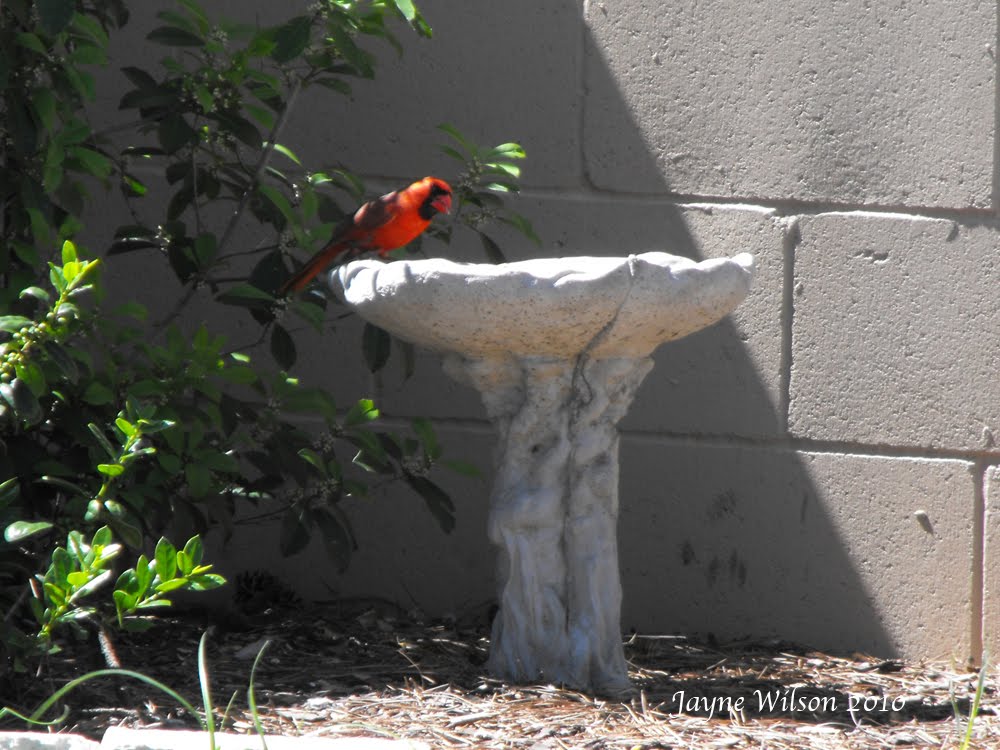
While this Red Cardinal took his turn at the bird feeder.


Since we moved in in the summer of 2008, we've had a steady succession of squirrels come to visit.  I never gave much thought to what type of squirrel they were until someone commented that, judging from a photo I had posted, they were Fox Squirrels.


Fox squirrels (Sciurus niger) larger than grey squirrels and have a rusty-colored underbelly and they are Texas' most common squirrel. In fact, it wasn't until earlier this spring that we saw any other type of squirrel in the garden.

The first squirrels to show up this year in the garden, following our freezing winter, were a group of three grey squirrels. They're quite a bit smaller than the fox squirrels and they have white underparts. Their tails don't seem to be as thick either.


Before I sign off, yesterday evening I got around to pulling out the spent pansies from the beds under the small trees in the front garden.  I left the bluebonnets which are still blooming (although they're almost finished) and which have some hefty seedpods on them. I filled in around them with some blanket flower, Gaillardia "Fanfare" and some Verbena "Hot Lips."


Now the trick will be making sure everything has enough water. It's a cruel fact that while parts of the country are having floods, we appear to be having a mini drought.

The rain barrel we installed a few weeks ago is turning out to be a great investment.  Soon after we installed it we had a couple of gentle rains which were enough to fill it to the brim! So I've been able to do a lot of my watering with FREE rainwater!

This weekend, I'll be setting up the new compost bin, which is our latest investment :-)

Words and photographs by Jayne Wilson, Green and Serene, Jayne's Country Garden.