Total Pageviews

Showing posts with label caterpillars. Show all posts

Tuesday, October 16, 2012

The Fall Garden

Ooops - here we are half way through October and this is my first blog post for the month.

My husband and I went up to Lake Conroe for a weekend getaway last week so I didn't get around to blogging.

I really haven't done much in the garden recently, but it seems to be thriving, in spite of the benign neglect.


The island bed just continues to bloom and flourish, although I realized too late that Pink Muhly Grass grows a lot bigger than I thought it did! There's an Artemisia between it and the Cat's Whiskers, but you can't see it.  I need to plan more carefully next year.


I may need some advice on what to do with this glorious mess along the back wall, and when to do it.

The Southern Wax Myrtle on the left is beloved by birds of all kinds. However, I planted it too close to the Rose of Sharon (center) and now it is shouldering it out of the way.  I don't want to move it, and I'm not sure the Rose of Sharon would survive a transplant. I may end up doing what I did when I moved from my previous house -- start some cuttings from it (this one started life as a cutting from the Rose of Sharon at my old house.
Next to/underneath/behind the Rose of Sharon is a Flame Acanthus.  When we had the mother cat and her kittens in the garden the summer before last, the kittens did a number on the Flame Acanthus with their rambunctious galloping round the flowerbeds.  I didn't know enough about it then to know if it was safe to prune it and tidy it up and well, I haven't done anything to it since either.  As a result, it's a shaggy mess.  I need to find out more about pruning these things.


In between the Rose of Sharon and the Dallas Red Lantana is this plant, which I have no idea what it is.  The bees seem to like it though!  I got it at the Houston Chronicle garden bloggers plant swap a couple of years ago and it's been sitting in a container tucked in behind the lantana since then.
I would have moved it and planted it in the ground somewhere, but it's firmly rooted to the ground, pot and all! Not sure what the best course of action is now - any advice would be appreciated.
We still have some Monarchs floating around, mostly nectaring on the lantana now, but they've apparently been busy laying eggs.


Some of the milkweed is in disgusting shape, covered in aphids, caterpillar droppings and chewed to bits, but there are yet another generation of caterpillars out there as I type! 
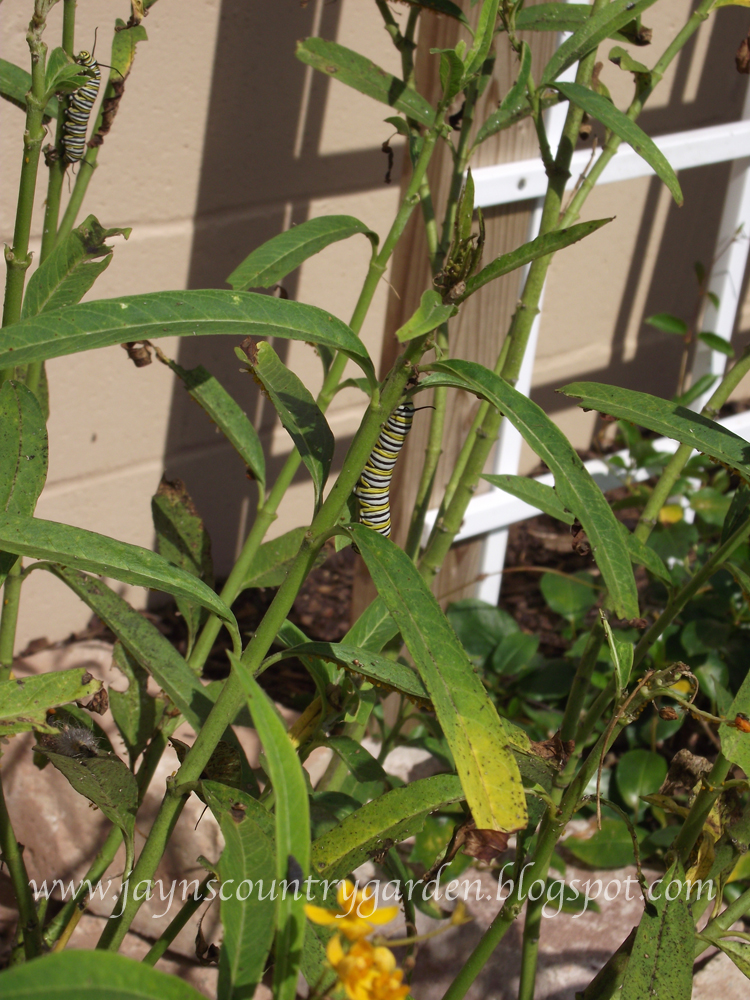

Edit: When I got home from work this evening, I went out in the rain to check on them and sure enough, they had eaten the yellow milkweed down to nubs, so I snipped off the stems they were on and relocated them to milkweed plants that still had leaves. 


OK - so I'm weird! 


Words and photographs by Jayne Wilson, Green and Serene, Jayne's Country Garden.


Saturday, June 23, 2012

More Monarch Progress!

One evening during the week, I headed out to the front garden with a view to pruning the milkweed, which have completely taken over the front border.  They're tall and straggly and I wanted to cut them back to encourage bushier growth, as the ones in the back garden have done.


However, as I bent over to prune, I came eye to eye with a fat juicy Monarch caterpillar.


 Moving on, I looked around some more and was delighted to count upwards of 15 caterpillars all steadily munching on the aforementioned out-of-control milkweed.


I made the decision then and there that the pruning could wait!  Since then I've been on caterpillar watch.


I was a little concerned yesterday evening as I was looking around and there seemed to be less caterpillars.  In addition, a mockingbird was keeping a wary eye on me and giving regular "chucks" of annoyance.  

Her behavior was strange and I thought that perhaps she had been eating the caterpillars and was annoyed at my presence.  However I have read that monarch caterpillars are unappealing to birds and are not eaten due to the presence of cardenolide aglycones in their bodies, which they ingest as they feed on milkweed.

Her strange behavior was suddenly explained a few minutes later when I went into my husband's den, which is at the front of the house.  I was standing by the window talking to my husband when a flurry of movement outside caught my eye.  I looked out and was thrilled to see a fledgling mockingbird clinging precariously to a milkweed stem.  "Mom" swooped down and gave a chuck of encouragement and flew up to the gable of the roof.  The little one fluttered to the next milkweed stem.

By the time I got outside with my camera, they were in the trees next door.  I couldn't see them, but I could hear mom still encouraging her offspring.

 So -- back to the Monarch caterpillars -- where were they all?  What had happened to them?

That's when I looked up to the gabled roofline of the house.  Oh what a wonderful sight!  There were several caterpillars, now hanging from the roof, obviously beginning the miracle of metamorphosis.

I took lots of photos of them, but unfortunately, when I went to take more photos this morning, I realized I've completely misplaced the Sandisk out of my camera!!!  We looked all over and couldn't find it. Hopefully it will turn up, but for now I don't have the photos I took of the caterpillars yesterday.


I did get this photo of a caterpillar picking out his spot this morning.


 He's not the first, as you can see from this longer shot.  The caterpillar is on the right.  Next to him are two new green chrysalises and further up to the left are some chrysalis shells from earlier this year.


 This one is right by the front porch and will be nice and easy to keep tabs on.


These three are on the west side of the house by the downspout.


This one didn't show much ambition -- where the others are all at least  8 feet off the ground, this one attached itself to the stonework a mere foot above ground level.  I hope it doesn't cook there - the area gets full sun.

So the total count is 7 right now (that I can find, anyway). If the caterpillar in the first photo makes it (it was still munching on milkweed this morning) it will be 8.  And if the caterpillar in the second photo makes it, the total will be 9.

I just hope they all make it -- I have read awful things about nasty bugs that suck the juices out of chrysalises and kill them.  We've done what we can, not sure what else we can do at this point.

Rather than get all melancholy about the unfairness of Mother Nature, I'm just going to Think Positive and hopefully we will have contributed to more Monarch Butterflies in the world.


Words and photographs by Jayne Wilson, Green and Serene, Jayne's Country Garden.